
Catégories
CFP Événement

Atelier SEM-SEW « Architecture and the Modernist Imagination »

Atelier SEM-SEW "Architecture and the Modernist Imagination", Congrès SAES 2027

Appel à contributions

Architecture has long been recognised as foundational to the infrastructure of modernity, at least since Constructivism first emerged among Russian artists around 1913 and advocated, well into the 1920s, for the integration of art, science and technology. As Mauro Guillén explains in The Taylorized Beauty of the Mechanical: Scientific Management and the Rise of Modernist Architecture (Princeton, 2006), “modernist architecture is the child of industry and engineering” (16). Guillén goes on to argue that “[architects] became technicians, organizers, and social reformers as well as artists”, as [t]echnology merged with style, science with history, efficiency with creativity, and functionality with aesthetics” (16). This workshop asks how, in turn, literature and the arts have responded to this profound upheaval, and how architectural thinking has helped shape modernist aesthetics, forms and imaginaries.
One familiar starting point is Manhatta (1921), the avant-garde, nine-minute film directed by Paul Strand and Charles Sheeler, which combines images of New York with excerpts from Walt Whitman’s poetry to create a decentered picture of an apparently unreal, maze-like metropolis. Yet this focus on the city as the central modernist architectural trope, if historically undeniable, is by no means sufficient to explain the role of architectural thinking within modernist works. For among the languages of modernism, architecture stands out as remarkably ubiquitous. It can evoke the visual turn in the literary imagination, with an emphasis on spatial concepts of form, from constellation to collage and montage, as well as the overall materiality of the printed page and the new textual and rhythmic geometries of the word. It can also point to the ways literary knowledge is assembled in anthologies into architectures of reading seeking to promote a different canon or exchanged and translated through the circulation of small magazines and periodicals. 
Beyond the representation of buildings and cities, architecture invites us to consider how modernist works construct, inhabit and transform space. Architecture does not simply fill space: it organizes it, creating places through the interplay of solid structures and the voids they enclose or leave open. By delineating spaces for particular activities and forms of life, architecture shapes how we move through and inhabit our surroundings. The tension between enclosure and openness extends beyond individual buildings to the urban environment and the relationship between built and natural spaces. Gardens, for instance, complicate this distinction: open to the sky, they nevertheless remain closely associated with enclosure, delimitation and domesticity. 
Modernist works can provide insight into our relationships to these structures and spaces. How might architectural principles illuminate literary composition, the organization of narrative, or the relationship between fragmentation and formal coherence? How do windows, doors, rooms and thresholds mediate between interior and exterior, private and public, individual consciousness and collective experience? In Virginia Woolf’s To the Lighthouse (1927), for instance, the family house becomes a material and temporal structure exposed to absence, decay and the passage of history; in A Room of One’s Own (1929), the room emerges as both a material condition of women’s intellectual independence and a figure for literary production itself. Such examples suggest that architectural space is never merely a backdrop: it can shape the conditions of authorship, the experience of modernity and the very forms through which they become thinkable.
Architecture also points to the intersection of aesthetic, social, political, historical and geographical frameworks that shape the modern world anew: where fiction is housed and where literary fiction chooses to dwell; the role of factories and the modern workplace; glass, steel, concrete and plastic, and the ecologies of durability they imply; the gendered organisation of domestic and public space; and the monuments and counter-monuments erected or torn down. Buildings and built environments may embody cultural memory and historical continuity, but they may also register rupture, displacement and the instability of inherited forms. From the modernist city to the domestic interior, from the architecture of the printed page to the material structures of cultural institutions, this workshop seeks to explore the multiple ways in which architecture informs, challenges and reshapes the modernist imagination.
We welcome contributions investigating how modernism makes, inhabits and transforms space. How do modernist literature and the arts negotiate the relationship between built space and artistic form? In what ways do architectural structures, principles and metaphors shape modernist experiments in literature and the arts? How do buildings and urban environments embody, reproduce or challenge social hierarchies, including those structured by gender, class, race and empire? How might architectural space be understood as an embodied and sensory experience, rather than merely a visual object or representational setting? What tensions emerge between architectural permanence and the shifting temporalities of modernity, historical memory and cultural inheritance? Finally, how might bringing architecture into dialogue with the arts complicate established understandings of modernism’s aesthetics, politics and historical legacies?

Les propositions de communication (300 mots) et une courte biographie sont à envoyer à Anne Besnault (anne.besnault@univ-rouen.fr), Nina Eldridge (nina.eldridge@u-bordeaux-montaigne.fr) ; Charlotte Estrade (cestrade@parisnanterre.fr) et Xavier Kalck (xavier.kalck@univ-lille.fr) avant le 30 novembre 2026.
Catégories
Événement

Conférence Lines of Motion

Conférence Lines of Motion: Depicting Movement in the Early 20th Century

19-20 novembre 2026

L’événement aura lieu entièrement en ligne.

Organisatrices: Charlotte Estrade & Emilie Georges ; Université Paris Nanterre

Catégories
Événement Evènements Non classifié(e)

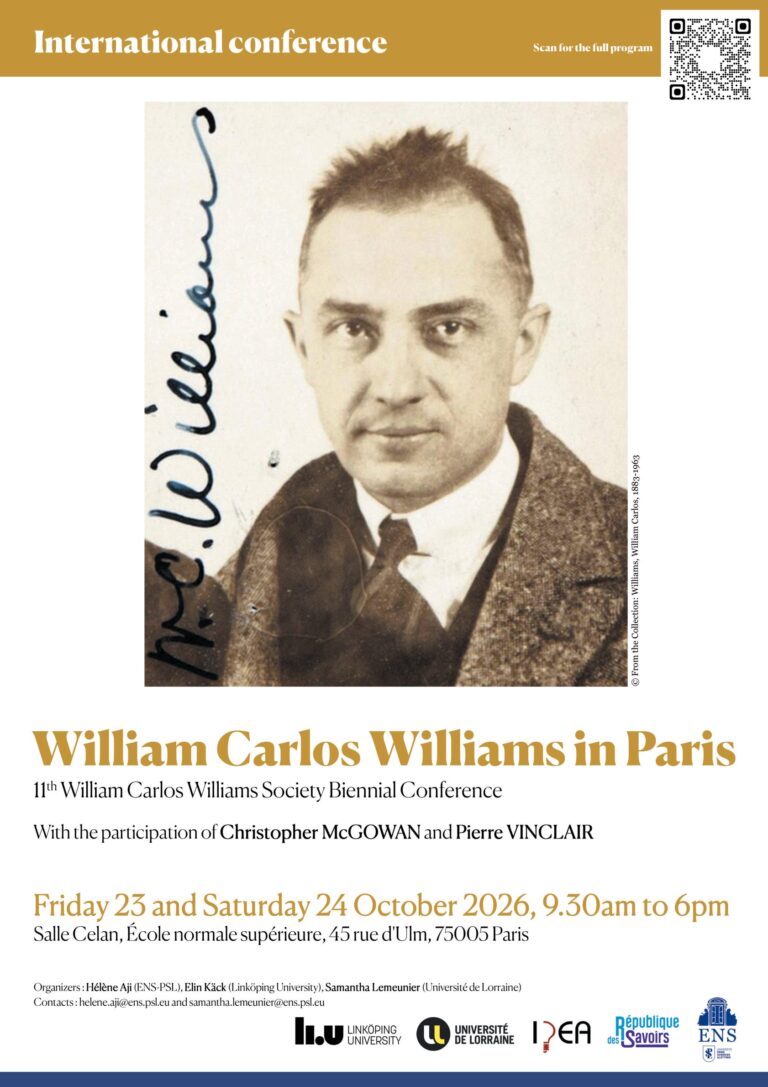
Conférence William Carlos Williams in Paris

William Carlos Williams in Paris

The 11th Biennial Conference of the William Carlos Williams Society

Dates: Vendredi 23 octobre et samedi 24 octobre 2026

Lieu: Salle Celan, École Normale Supérieure, 45 rue d’Ulm, 75005 Paris

Programme

Lien d’inscription (gratuite, mais obligatoire pour entrer dans l’ENS)

Catégories
Non classifié(e)

Modernist Sex

Modernist Sex

24-26 June 2026, Nanterre and Paris

DUE TO EXTREME WEATHER CONDITIONS, THE PROGRAM HAS BEEN ADAPTED AND THE LOCATION FOR FRIDAY HAS CHANGED. MORE INFORMATION BELOW.

We are very much looking forward to meeting you at the 6th SEM conference! It will begin at 14.00 on Wednesday June 24 and end at 17.00 on Friday June 26, 2026.
 
On June 24 and 25, it will be held at the Université Paris Nanterre, Bâtiment Weber, 200 Avenue de la République, 92000 Nanterre. The
University can be reached in about 20 to 30 minutes from Paris by
the RER (fast metro linking Paris to suburbs) line A, or an L train
from Gare Saint-Lazare to “Nanterre Université.”
Map: https://bienvenue.parisnanterre.fr/plan-du-campus (the “Bâtiment Weber” is located near the “N” on the map).
 
On June 26, it will take place at the Université Paris Cité, Amphi Buffon, 15, rue Hélène-Brion, 75013 Paris (RER C /Métro
14 to “Bibliothèque François-Mitterrand”, or Tram T3a « Avenue de France »)
. Map: https://u-paris.fr/wp-content/uploads/2022/09/PlanB5_PRG_0922.pdf.
 
Registration is now closed. The enrollment fees for the conference are 30 euros for PhD students and 70 euros for other speakers (keynotes excepted). Please note that you also need to become a member of the SEM to speak at the conference. SEM membership fees are 10 euros per year for PhD students, 15 euros for members who hold temporary positions, and 25 euros for other members. 
  
Buffet lunches on the 25th and 26th are included in the conference fees, but the conference dinner is not, and will be paid for separately by those who wish to attend. It will take place on Thursday June 25.


Catégories
Non classifié(e)

Elementor #2689

Modernist Sex - Program

 Downland program (as of June 24, 2026)

Wednesday, June 24th – Nanterre


13:15-13:45 15:00

Welcome and Registration

Bâtiment Weber, ground floor, entrance hall

13:45 14:45

Conference opening

14:00-15:00

Bâtiment Weber, ground floor, salle de conférences

Keynote

Rachel Potter: Libertine Modernism

Chair: Charlotte Estrade

15:00-15:15

Break


Bat. Weber, ground floor, salle de conférences

Bat. Weber, ground floor, room: Seminaire 2

Bat. Maier, ground floor, room: R14

15:15-16:45

Women, Sex and the Boundaries of Form/Genre

Chair: Emma Frigo

Leila Michelle Vaziri: ‘“The central point toward which life and death are spinning”:

Pregnancy’s Forms in the Modernist Novel’

Kirsten MacLeod: ‘“Aged freaks are all the rage”: The élégante as Modernist Female Type‘

Stacy Gillis: ‘“A Work of a Tendency So Grossly Immoral”: Public Morals, Copyright, 

and Women’s Writing in the Early Twentieth Century’

Magazines and book series

Chair: Benoît Tadié

Céline Mansanti: Sex and its suppression in the new US humor magazines of the 1920s

Will Straw: Sexual content and form in New York’s sensational magazines of the 1920s

Max Saunders:  Modernist Sex To-day and To-morrow


Against Sex

Chair: Lacy Rumsey

Fiorenzo Iuliano: “A more durable purity”: Jewish Sexuality and the Struggle for Americanness in Henry Roth’s Call It Sleep

Zakir Paul: “Modernist Erotophobia”

Bérengère Riou: “turn from easy pleasure”: Resisting Sex in H.D.


16:45-17:00

Break

17:00-18:30

Transidentity and non-binary identity

Chair: Chloé Thomas

Jenny Scoones and Laura Ludtke: The Trouble with Tiresias: Reading for Glandular Discourse in Eliot’s The Waste Land (1922) and Sackville-West’s The Land (1926)

Chris Coffman: Nonbinary Sexuality in Bryher’s “Hellenics” and “Myiskos”

Jaime Hovey: Girl won and lost: sporting transmasculinity in Radclyffe Hall’s The Well of Loneliness and Enid Bagnold’s National Velvet 

Colonial and Postcolonial sex

Chair: Céline Mansanti

Atim Mackin: (Pseudo)-Charting Colonial Sexualities: Docteur Jacobus’ Amour aux colonies (1893)

Sean Mark: “[E]verybody look like they frustrated in the big city the sex life gone wild”: On Sex in The Lonely Londoners

Justine Baillie: The Economy of Survival in Jean Rhys’ Voyage in the Dark and Good Morning, Midnight and Claude McKay’s Banjo


Surveillance, censorship

Chair: Zakir Paul

Rose Ducharme: Sex, Surveillance, and the British Empire in Claude McKay’s Writings on Jamaica

Andrew Thacker: “the spicy kind of books”: Sex and Censorship in the Modernist Bookshop

Agata Ida Kozuchowska:  Picturing the perverse: the surreal, the Bizarre and issues of censorship in John Willie’s vintage S/M erotica


Thursday, June 25th – Nanterre


Bat. Weber, ground floor, salle de conférences

Bat. Weber, ground floor, room: Seminaire 2

Bat. Maier, ground floor, room: R14

9:00-10:30

Queerness (1)

Chair: Henry Carmines

Maurizia Boscagli: The Bed, and the Boat: Queer Sexuality in Djuna Barnes and Eileen Grey

Regine Eurydike  Hader: Modernist Dance Portraits as Queer and Gay Geometries

Ian Jayne: “Serious pleasure”: Narrating Queer Sexuality in Maurice and Alec


Maleness, masculinity, virility (1)

Chair: Maïwenn-Iman Zekri Le Garff

Fabio Colonnese:
Luigi Moretti, Ettore Muti and the architectural representation of the fascist myth of virility

Kimberly Kotel: Space and Sexual Crowding in Miller’s Tropic of Cancer

Emma Frigo: “A nice cunt sandwich”: Henry Miller’s alimentary and sexual hunger(s)


Promiscuity and Secrecy

Chair: Charlotte Estrade

Philippe Birgy:  Compromising promiscuity and entangling connexions in and around Rebecca West’s “Indissoluble Matrimony”

Joseph Owen: Secrecy and Obscenity in Lady Chatterley’s Lover

Rachel Haines: Schoolgirls in love: The Queer Desire to be Smart in Dorothy Strachey’s Olivia


10:30-11:00

Break

11:00-12:30

Queerness (2)

Chair: Fiona Fleming

Andrew Koenig:  Isherwood, Hockney, and Gay (Post)modern(ist) Identity in LA.

David Reckford: “I will always love you though I never loved you”: the haptics of differently oriented New York School poets and artists

Maxime Petit:  “The Actual Deed of Sex”: Homosexuality, Obscenity and Censorship in the Fiction of E.M. Forster


Maleness, masculinity, virility (2)

Chair: Hélène Aji

Jane Malcolm: From Male Genius to the Mother of Us All: Gertrude Stein and Dashiell Hammett Talk Sex and Gender

Clément Oudart: ‘You mean coitus?’: Priapus in the land of the eunuchs, or the stakes of hypersexualized writing in Hemingway, Fitzgerald and Dos Passos.

Thirthankar Chakraborty: A Crisis of Masculinity in Beckett’s Murphy and Ananthamurthy’s Samskara


Hysteria, Perversion, Obscenity

Chair: Naomi Toth

Rosaria Murolo:  Augustine’s Gaze: Hysteria as Perversion of Bourgeois Sexuality

Tobias Jenkins: After Strange Gods: Masud Khan and Sexual Perversion

Savina Stevanato: Is “this stuff […] too stiff for us”? The Case of Eliot’s Sexual and Bawdy Poems


12:30-14:00

Lunch

14:00-15:30

Queerness (3)

Chair: Hélène Aji

Karo Strauch: Lesbian Polyamorous Utopia: Queer Futurity in Natalie Barney’s Women Lovers or The Third Woman

Naomi Toth: Against possession – Orlando Erotics

Melissa Bradshaw: “Who’s that Lady?: Decoding Intimacies in Amy Lowell’s Letters

Femininity and the female body (1)

Chair: Juliette Utard

Nora Pehrson: Modernist periods

Lou Pinelli: The Modernist Second Sex: Simone de Beauvoir as a reader of Anglophone Modernist women writers

Gina Stamm: Femme-enfant-animal: Greta Knutson’s Sex and Structural Violence


Ambiguous Spaces

Chair: Flore Coulouma

Peter Kurtz: “Dat sure is the sullibrated word!”: Magdalene Laundries and Sequestered Sites of (Re)circulation in Finnegans Wake’s Poetics of Waste and Sex

Louise Kane: Zhang Ailing’s “Sealed off”: Sex, Shanghai, and Chinese Modernism

Maurice Fadel:  Ambiguity and Sexuality in Formalist Literary Theory


15:30-16:00

Break

16:00-17:30

Representing Sex

Chair: Anne-Marie Paquet-Deyris

Patrick Armstrong:  Scientific Films, Sex and Spectatorship

Enda Duffy:  The Fire: Sexuality and an Alt-Biopolitics of Modernism

Kevin Kennedy: Sex and Silence: Susan Sontag and The Failure of Representation in Modernist Literature


Femininity and the female body (2)

Chair: Anne-Pascale Bruneau-Rumsey

Izabela Sobczak: Fragmented Figures: Modernist Metonymies of Desire (Djuna Barnes, Virginia Woolf, and Hans Bellmer) 

Neethi Alexander:  Erotics of the Unbeautiful: Sexuality, Ageing, and the Female Body in the works of Elsa von Freytag-Loringhoven and Djuna Barnes

Barthélémy Rolland : From “Lost” and “Found” to “For Paul”: Lorine Niedecker’s Politics of the Body After Sex

Degeneration, eugenics and birth control

Chair: Henry Carmines

Sylvain Belluc: Eugenics and Birth Control in James Joyce’s “The Dead”

Janice Ho: Birth Control and The Politics of Development in Aldous Huxley’s The Island 

David Ludwig: Sex, Modernism and Degeneration: Antimodernist Discourses from the Sittlichkeitsbewegung to Spengler


19:30

Conference dinner

Le Cercle

12, rue Clément, 75006 Paris


Friday, June 26th– Paris-Cité


Amphi H8C Buffon

Room HF404B Buffon 103A

Room HF406B Buffon 146A

9:00-10:30

Visual arts (1): the nude

Chair: Anne-Pascale Bruneau-Rumsey

Jane Garrity: Art Monster: Vanessa Bell’s Photographs of Nude Girls

Anastasia G. Wildig: Intimate portraits: an examination of the artist-muse relationship and interpretations

of the female nude during the modernist period

Sirine Germani: From Orientalist Gaze to Pluralist Desire: The Politics of the Nude in Lebanese Modern and Contemporary Art

The politics of sexual liberation

Chair: Olivier Hercend

Karla Kelsey: “The Vaginal Cry”: Martha Graham, Anaïs Nin, and Sexual Politics

James Dowthwaite: ‘Naked Liberation’: Sex and Modernism in Stephen Spender’s Hamburg

Allan Hepburn: Muriel Spark and the Sexual Revolution


Esotericism and Modernism: Hidden Knowledge Masking the Reproduction of the Normative (1)

Moderator: Brennan Kettelle

Jessica Albrecht: Masculinity and the Empire: Negotiations of Normativity between W. B. Yeats and R. Tagore

Tanya Cheadle : Heroic Masculinity, Neo-Paganism and Celtic Revivalism in the Adventure Romances of John William Brodie Innes (1848-1923)


10:30-11:00

Break

11:00-12:30

Visual arts (2): expressionist & dada sex

Chair: Astrid Maes

Cole J. Graham: Bodily Matters: Egon Schiele and the Erotics of Disability

Martin Harries:  Sexuality in Kurt Schwitters’ Collages

Zanë Hadri: The Zero-Degree of Emotion: Francis Picabia’s Mechanomorphism as Affective Diagram of Modern Sexuality


Sex, writing and reading

Chair: Daniel Jean

James Dutton: Taste Matters: Proust, Writing and Dying for Sex

Brian Richardson:  Reading and Sex in Modernist Fiction

Samantha Lemeunier: “A secret having to do profoundly with her sex”:  William Carlos Williams’s Eroticization of Women’s Writings


Esotericism and Modernism: Hidden Knowledge Masking the Reproduction of the Normative (2)

Moderator: Brennan Kettelle

Christine Ferguson: Dion Fortune and Magical Miscegenation in the 1920s Occult Milieu. 

Manon Hedenborg White: Turbaned Orientals and women of the underworld”: Whiteness and heterosexuality interrupted in early-20th century tabloid portrayals of Aleister Crowley

Hubert Cook: Bodied Knowledge Protocols: James Baldwin’s Modern Speculations of Sex and Captivity


12.30-14:00

Lunch

14:00-15:00

Keynote

Jean-Michel Rabaté: “All were lacking if sex were lacking”

          Freud, Eliot, Woolf, and Sackville-West

Chair: Benoît Tadié

Room: Amphi H8C Amphi Buffon

15:00-15:30

Break

15:30-17:00

Visual arts (3): the male gaze and female exploitation

Chair: Anne-Pascale Bruneau-Rumsey 

Ya’ara Gil-Glazer: From Fin-de-Siècle Misogyny to Countercultural Women’s Liberation: Art Nouveau’s Sexual Imagery Reframed

Camille Rollando-Kozlowski: The City of Light, the City of Desire: Photography and Sexual Difference in Modernist Paris

Ciaran Hervás: Eros in the Museum: Magnus Hirschfeld’s Sexological Museum in Photo-illustrated Magazines


Modernist Seductions

Chair: Xavier Kalck

Olivier Hercend: Joycean Seduction: from the Heavens to brothels via billboards and pick up artists

Shirley Bricout: Adam and Eve: Figures of reclaimed sexuality in D. H. Lawrence’s works

Astrid Maes:  Faulkner’s Sexual Poetics of Ecstasy


Catégories
Événement

Atelier SEM/SEW Modernist Emancipations

CALL FOR PAPERS

Congrès de la SAES. Université de Poitiers – 3 au 5 juin 2026

« Emancipation »

How shocking and yet how wonderful it was to discover that these real things, Sunday Luncheons, Sunday walks, country houses, and tablecloths were not entirely real, were indeed half phantoms, and the damnation which visited the disbeliever in them was only a sense of illegitimate freedom. What now takes the place of those things I wonder, those real, standard things? Men perhaps, should you be a woman; the masculine point of view which governs our lives, which sets the standard, which establishes Whitaker’s Table of Precedency, which has become, I suppose, since the war half a phantom to many men and women, which soon, one may hope, will be laughed into the dustbin where the phantoms go, the mahogany sideboards and the Landseer prints, Gods and Devils, Hell and so forth, leaving us all with an intoxicating sense of illegitimate freedom— if freedom exists… (Virginia Woolf, “The Mark on the Wall”, 1917)

Shaped in the shadow of the First World War, this quotation captures both the aspirations and doubts of an entire era. It points to the power of alternative modes of perception and expression to challenge social conventions, power hierarchies and inherited cultural norms which the experience of historical trauma had profoundly questioned. Modernist aesthetic production and cultural practices indeed intersected with, though did not fully mirror, the political struggles for emancipation that so characterized the first decades of the 20th century on both sides of the Atlantic and across the globe. Yet the possibility that that “freedom”, however imagined, might be ambivalent or unattainable for all, is clearly present amongst modernist artists, writers, and critics. Well before New Modernist Studies in the 1990s underscored that modernism – though bound up with the rhetoric of liberation in art, experience, and politics – was never an unambiguous force of emancipation, its fault lines were already visible. To examine “modernist emancipations” is to reflect on the ways liberating energy expressed itself – through its strategies, forms, and achievements, but it also calls for a consideration of its contradictions, limits and failures. We invite papers which consider these questions within the work of a single artist or in the conversations, debates and conflicts connecting several artists and generations. 

Organised jointly by the Société d’Études Woolfiennes (SEW) and the Société d’Études Modernistes (SEM), this workshop invites proposals that address the notion of emancipation from a diverse range of perspectives (aesthetic, social, ideological, political, material…), across forms, genres, media, and geographic borders. We are particularly interested in papers exploring the contradictions inherent in modernist thought and practice around emancipation.

Proposals for papers in English (300 words + short bibliography) and a brief biographical

note should be sent jointly to Anne Besnault (anne.besnault@univ-rouen.fr) and Naomi Toth

(ntoth@parisnanterre.fr) before November 30th 2025.

Catégories
CFP

Modernist Sex

6th International conference of the French Society for Modernist Studies

Université Paris Nanterre, 24-26 June 2026

Call for Papers

Deadline for abstracts: 30 September 2025

In her “Feminist Manifesto” (1914, published 1982), Mina Loy writes “there is nothing impure in sex—except the mental attitude to it.”[1] This programmatic statement eloquently sums up the collective battle that modernist artists waged against the prudishness imposed by Victorian culture and American Puritanism, in which sexuality, reproduction and the body were strictly kept sub rosa. Modernist artists’ commitment to breaking those taboos in both their lives and their artistic production inevitably led to accusations of obscenity targeting many iconic figures and works, causing modernist literature itself to be compared to a form of pornography by its detractors, as studies like Rachel Potter’s Obscene Modernism: Literary Censorship and Experiment, 1900-1940 have amply explored. Oscar Wilde’s trial for “gross indecency” in 1895 gave the initial impetus to what Paul Sheehan calls “a particularly forceful style of modernist sexuality,”[2] and marked the beginning of a series of key legal clashes between modernist writers and morality-enforcing authorities like the New York Society for the Suppression of Vice, which targeted with equal zeal the birth control pamphlets distributed by feminist activists and key modernist works such as James Joyce’s Ulysses or D.H. Lawrence’s Lady Chatterley’s Lover. Henry Miller’s 1934 Tropic of Cancer remained censored for obscenity in the U.S. until the Supreme Court decision which officially allowed its publication in 1964 (Grove Press, Inc. v. Gerstein).

However, these provocative modernist works—and others, such as Hemingway’s The Sun Also Rises (1926) or William Faulkner’s Sanctuary (1931)—also resist the facile celebration of sexuality as able-bodied vitality, and instead interweave it with other key modernist themes like failure, difficulty, violence, castration and impotence in the wake of the physical and psychological trauma of the Great War. Others, including Claude McKay’s posthumously published Romance in Marseille (ca. 1929-1933, published 2020), create fruitful intersections between sexuality and disability by showing how disability may become the source of alternative forms of erotic pleasure. While modernist writings and art revisit, often through a very gendered and politicized lens, such figures and loci of forbidden fantasy as the sex worker and the brothel, modernism is also marked by the rejection of heteronormative paradigms and a commitment to a frank and uncompromising representation of queer desire, as illustrated by Bloomsbury artist Duncan Grant’s hundreds of gay erotic drawings, which have recently come to light, or by texts like Gertrude Stein’s Q.E.D. (1903) or Richard Bruce Nugent’s “Smoke, Lillies and Jade” (1926), among many others. Still other feminist and lesbian approaches to sex displace erotic energy from coitus towards other objects and across the text itself, as in Stein’s Tender Buttons (1914) and Virginia Woolf’s Orlando (1928). Other authors, like E.M. Forster, explored homosexual desire in works that were published posthumously, such as the novel Maurice (1914, published 1971) and the story “The Life to Come” (ca. 1922, published 1972). The time lag in fact bears witness to the homophobia and repression of queer identities and practices that were concurrently trademark features of a long-predominant white male masculinist trend in modernism.

Oscar Wilde’s expatriation to France in the wake of his trial and imprisonment marked the beginning of the wave of interwar artistic expatriations in search of environments more propitious to the creation of sexually liberated alternative communities in the margins—encapsulated by texts like Djuna Barnes’ roman à clef, Ladies Almanack (1928). The publication of Mina Loy’s “Love Songs” in the little magazine Others, the serialization of Ulysses in The Little Review and of Richard Bruce Nugent’s work in the Harlem Renaissance little magazine Fire!! also underscores the role of little magazines in the dissemination of texts considered to be obscene. At the other end of the cultural spectrum, American pulps and related racy or “spicy” magazines, often influenced by such French periodicals as La Vie parisienne, Le Rire or Le Sourire, offered venues between the 1910s and 1930s for a conversation on sex in the shadow of the “new puritanism” denounced by H. L. Mencken.

The early twentieth century was also marked by a proliferation of scientific—and pseudoscientific—theories about sexuality and the differences between the sexes, like Otto Weininger’s monumental Sex and Character (1903), Freud’s Three Essays on the Theory of Sexuality (1905) or Havelock Ellis’ multi-volume Studies in the Psychology of Sex (1897-1900), breaking new ground in mapping unconscious desire but also producing problematic paradigms infused with misogyny or homophobia, like the figure of the “invert,” ambivalently interwoven in queer modernist narratives like Radclyffe Hall’s The Well of Loneliness (1928) and Djuna Barnes’ Nightwood (1936). Likewise, Freud’s influential theory of female “penis envy” is an emblematic example of the thorough-going gender bias that Simone de Beauvoir would later decry in her key feminist study The Second Sex (1949).

The avant-gardes each devised novel and often contradictory ways of addressing the theme of sex: while Futurism attempted to strip sexuality from outdated sentimentalism, there is a stark contrast between the rampant misogyny of F.T. Marinetti’s manifestos and the ecstatic celebrations of female sexuality in Valentine de Saint-Point’s “Futurist Manifesto of Lust” (1913). In early modernist art movements like Fauvism, Cubism and Expressionism, female and male nudes frequently evoked an uninhibited sexuality. The works’ deformations of the figure and their integration of forms derived from non-western art broke with conventionally erotic academic models, while the turn to the “primitive,” even as it defied social norms, retained some of the prevalent gendered and racial preconceptions of the time. Dada and Surrealism deployed sexual provocation as an integral part of their épater le bourgeois strategies, using linguistic punning infused with sexual innuendo, the projection of human characteristics on objects and animals, and cross-dressing, to unsettle the unconscious and to deconstruct essentialized visions of sexual difference and heteronormative desire by underscoring the idea of gender as performative.

This international conference aims to prompt new reflections on the aesthetics and politics of sex in the modernist period—both in the sense of probing sexual difference and of mapping the uncharted territories of sexual desire. We invite papers tracing novel intersections across questions of sexuality and gender, class, race, and disability, or offering new perspectives on these well-known early twentieth-century scandals, tensions and debates around sex and sexuality.

Proposals for individual papers, joint panels, and roundtable discussions are invited on the following (non-exclusive) fields of enquiry in connection with modernism, the modernist era and in modernist texts, as well as in the visual and performing arts:

  • Representations of sex and sexual practices in modernist literature and art
  • The role of magazines and other modernist infrastructures in disseminating new sexual representations
  • The sexual politics of modernism (gender, race and class)
  • The ambivalent figure of the sex worker
  • Sex and reproduction
  • Challenges to heteronormativity
  • Intersections between sexuality and disability
  • Theories of sexuality and their influence on literary and artistic production
  • Community, expatriation, and publication abroad, and the quest for sexual freedom
  • Sex and censorship
  • Representations of sexuality in colonial or imperial contexts
  • The sexualised or desexualised body, and the modernist rethinking of the relation of the reproductive or somatic dimensions of biology to sex and eroticism
  • The conservative or antagonistic positioning of many modernist authors to questions of changing sexual identities and practices
  • Sex and the urban environments of modernity
  • Emergent psychologies of sex and sexuality and their impact on Modernist production

Please send your abstracts (250-300 words), accompanied by a short biographical note, to the following addresses: btadie@parisnanterre.fr and chloe.thomas@u-paris.fr

Scientific Committee: 

Hélène Aji (École Normale Supérieure)

Yasna Bozhkova (Université Paris Nanterre)

Anne-Pascale Bruneau-Rumsey (Université Paris Nanterre)

Charlotte Estrade (Université Paris Nanterre)

Xavier Kalck (Université de Lille)

Christos Hadjiyiannis (Universität Regensburg)

Nicholas Manning (Université Grenoble Alpes)

Clément Oudart (Sorbonne Université) 

Benoît Tadié (Université Paris Nanterre)

Chloé Thomas (Université Paris Cité) 

Naomi Toth (Université Paris Nanterre)

Bibliography:

ARMSTRONG, Tim. Modernism, Technology and the Body. Cambridge: Cambridge University Press, 1998.

BOONE, Joseph Allen. Libidinal Currents: Sexuality and the Shaping of Modernism. Chicago, IL: University of Chicago Press, 1998.

COLLIGAN, Colette. A Publisher’s Paradise: Expatriate Literary Culture in Paris, 1890-1960. Amherst: University of Massachusetts Press, 2013.

CRANGLE, Sara. Nethered Regions – An Anatomy of Mina Loy. Edinburgh: Edinburgh University Press, 2024.

FREED-THALL, Hannah. Modernism at the Beach. Queer Ecologies and the Coastal Commons. New York: Columbia University Press, 2023.

FROST, Laura Catherine. Sex Drives: Fantasies of Fascism in Literary Modernism. Ithaca, NY: Cornell University Press, 2002.

FROULA, Christine. Modernism’s Body: Sex, Culture, and Joyce. New York: Columbia University Press, 1996.

GUILLAIN, Aurélie, and Philippe BIRGY. “Modernism and the Obscene.” Miranda 21 (2020). https://journals.openedition.org/miranda/27682.

HONEY, Maureen. Aphrodite’s Daughters: Three Modernist Poets of the Harlem Renaissance. New Brunswick: Rutgers University Press, 2016.

LAITY, Cassandra, and Nancy K. GISH, eds. Gender, Desire and Sexuality in T.S. Eliot. Cambridge: Cambridge University Press, 2004.

LAMOS, Colleen. Deviant Modernism: Sexual and Textual Errancy in T. S. Eliot, James Joyce, and Marcel Proust. Cambridge: Cambridge University Press, 1998.

MARSHIK, Celia, and Allison PEASE. Modernism, Sex and Gender. London: Bloomsbury, 2018.

PAPA, Victoria. “‘Clean, Original, Primitive’: Sexual Radicalism, Race Consciousness, and the Case of Harlem’s Queers”. Modernism/modernity Print Plus, Volume 6, Cycle 2. 23 Juin 2021. https://doi.org/10.26597/mod.0203.

PEASE, Allison. Modernism, Mass Culture, and the Aesthetics of Obscenity. Cambridge: Cambridge University Press, 2000.

PINKERTON, Steve. Blasphemous Modernism: The 20th-Century Word Made Flesh. Oxford: Oxford University Press, 2017.

POTTER, Rachel. Obscene Modernism. Oxford: Oxford University Press, 2013.

RASCHKE, Debrah. Modernism, Metaphysics, and Sexuality. Selinsgrove: Susquehanna University Press, 2006.

SCHAFFNER, Anna Katharina. Modernism and Perversion: Sexual Deviance in Sexology and Literature, 1850-1930. New York: Palgrave Macmillan, 2012.

SCHAFFNER, Anna Katharina, and Shane WELLER, eds. Modernist Eroticisms: European Literature After Sexology. London and New York: Palgrave Macmillan, 2012.

STEVENS, Hugh. Henry James and Sexuality. Cambridge: Cambridge University Press, 2009.


[1] Mina Loy, The Lost Lunar Baedeker, ed. Roger Conover (Manchester: Carcanet, 1997), 156.

[2] Paul Sheehan, “Modernist Sexual Politics,” in Modernism and the Aesthetics of Violence (Cambridge: Cambridge University Press, 2013), 109.

Catégories
Non classifié(e)

Günter Leypoldt (Heidelberg): Dense Networks: Patronage, Peer Review, and the Rise of Modernism

Friday, April 11th, 2025 – Université Paris-Cité, Bâtiment Olympe-de-Gouges, room 830.

This paper will suggest an institutional account of modernism’s increasing cultural relevance after 1900. Iconic modernists like Woolf, Joyce, Pound or Eliot were embedded in “dense networks” (groups in which everyone has close intellectual-emotional ties to everyone else). Dense networks, I argue, heighten the reflexivity of literary practice, and tend towards validation through peer review rather than the literary marketplace. Whereas earlier peer-oriented literary coteries (like the Weimar-Jena group around Goethe and the Schlegels, or the English Wordsworth-Coleridge circle) relied heavily on patronage and independent wealth, the mid-to-late century print-market extensions provided inverse subsidies that gradually strengthened literary culture’s market-sheltered peer review systems. When modernism’s new platforms (rentier-financed little magazines and the like) created more stable market shelters, this led to the avant-gardization of the literary field’s economies of prestige during the 1920s, elevating modernism’s reflexive experimentalism to the literary center. Modernism’s more lasting institutionalization, finally, needs to be understood in terms of the more sustained turn to academic patronage in the post45 period.

Günter Leypoldt is a Professor of American Literature and Culture at the University of Heidelberg. He is the author of Literature’s Social Lives: A Socio-Institutional History of Literary Value (forthcoming in 2025), Cultural Authority in the Age of Whitman: A Transatlantic Perspective (2009), and co-editor of Authority and Trust in US Culture and Society (2021) and Reading Practices (2015). His essays appeared in such journals as American Journal of Cultural Sociology, American Literary History, Poetics, Modern Language Quarterly, New Literary History, Critical Quarterly, Contemporary Literature, and Post45.

Catégories
Non classifié(e)

Elementor #2443

Journée d’études Modernist Hands

28 mars 2023

Université Paris Nanterre, bâtiment Weber, salle de séminaires

Organisatrices : Solveig DUNKEL et Charlotte ESTRADE (Nanterre, CREA)

9h – Accueil café

9h30 – Introduction : Françoise Kral, directrice du laboratoire CREA

Atelier 1 (modératrice : Solveig Dunkel)

10h – Caroline Pollentier (Université Sorbonne Nouvelle – IUF), “Virginia Woolf and the Laws of Tact”

10h30 – Leslie de Bont (Nantes Université), “‘All that fuss about a hand!’ Social norms, modernist affect and Sinclairian imagism”

11h – Naomi Toth (Université Paris Nanterre – IUF), “The failure of immediacy. Hands and the phenomenology of perception in Virginia Woolf’s The Waves”

11h30 – Elise Brault (Université Polytechnique des Hauts-de-France), “In the doctors’ hands”

12h – Discussion/questions

Lunch


Atelier 2 (modérateur : Benoît Tadié)

14h30 – Samantha Lemeunier (ENS Ulm), « Écrire sans main : paralysies poétiques dans les œuvres tardives de William Carlos Williams »

15h – Frédérique Spill, « La main à l’ouvrage : la figure du charpentier chez Faulkner »

15h30 – Charlotte Estrade, « Poings et gants : force de frappe des écrivains et boxeurs modernistes »

16h – Discussion/questions

 
Catégories
Non classifié(e)

Elementor #2322

Therapeutic Modernisms
5th International Conference of the SEM
19-21 June 2024, Grenoble

Organizers :

Hélène Aji (École normale supérieure – PSL)

Nicholas Manning (Université Grenoble Alpes)

Benoît Tadié (Université Paris Nanterre)


Download the conference program